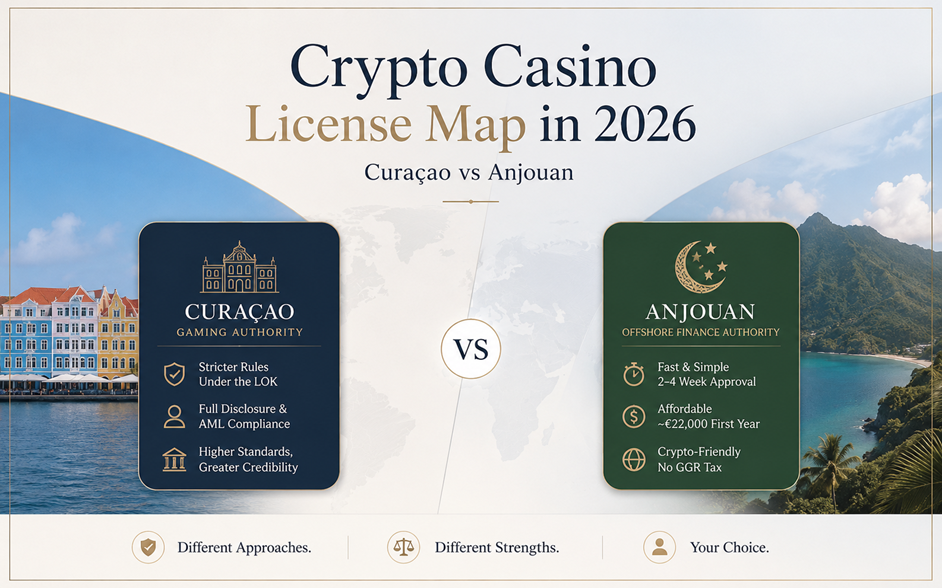
Two offshore regulators dominate the crypto casino sector. Both issue licences that cover casino, sportsbook, and crypto payments. Both sit thousands of miles from the players using them. Over the past two years, one tightened its grip while the other threw the doors open, and the difference now shows up in which logos appear at the bottom of which casino footer.
Curaçao Cleaned Up
The National Ordinance on Games of Chance, known across the industry as the LOK, officially took effect on 24 December 2024. It abolished the old master licence system that had defined Curaçao’s iGaming reputation for more than two decades.
Under the old regime, a handful of master licensees handed out sublicences to hundreds of operators with minimal oversight. Curaçao asked few questions about who actually ran each casino. The LOK ended that. Every operator now applies directly to the renamed Curaçao Gaming Authority, with full disclosure of Ultimate Beneficial Owners, AML and KYC compliance plans, segregated player fund accounts, and fit-and-proper checks for senior management.
Legacy sublicences expired in January 2025. By the end of Q1 2025, the CGA expected around 600 operators to hold direct licences under the new system. Annual fees run roughly €47,000 for a B2C licence and €24,000 for B2B. Local staffing and office presence become mandatory from 2028.
For operators who built businesses on the old “no questions asked” approach, the LOK is an existential problem. For everyone else, it’s a credibility upgrade. A 2026 Curaçao licence now signals a casino that survived the audit, not just one that paid the fee.
Anjouan Filled the Gap
While Curaçao tightened, Anjouan opened. The Anjouan Offshore Finance Authority reopened to online gaming in 2023, and by 2025, more than 950 casinos were operating under its jurisdiction. The 2025 Yogonet iGaming Report flagged over 200 new licences issued in the past twelve months, a 60% year-on-year jump.
The pitch is simple. Roughly €22,000 for the first year, approval in 2-4 weeks, no tax on gross gaming revenue, and one licence covering casino, sportsbook, poker, esports, lottery, and crypto gaming. Compare that to the LOK’s six-figure setup costs and months of compliance work, and the appeal becomes clear fast.
Crypto-first operators have moved to Anjouan in significant numbers. Toshi.bet secured its Anjouan licence in 2026 while keeping the no-KYC, instant-withdrawal model intact. Shuffle.com operates under the same framework. So do 96.com, Rainbet, and dozens of newer brands.
The AOFA introduced B2B Recognition Certificates in mid-2025, forcing software providers to meet higher technical standards. That’s a real step up. But oversight remains lighter than Curaçao’s new regime, and dispute-resolution mechanisms are not on the level of Tier 1 jurisdictions like Malta or the UK Gambling Commission.
What It Means for Players
A 2026 Curaçao licence is harder to come by and means more. The operator has identified its owners, segregated player funds, and signed up for ongoing AML and responsible gaming obligations. That’s not Malta or the UKGC, but it’s a real step up from the master licence days.
A 2026 Anjouan licence means the operator was vetted, paid its fees, and passed a fit-and-proper check. The framework exists, but oversight is light and the regulator is still building its reputation. Quick-launch crypto casinos with thin track records often carry Anjouan credentials by default.
Neither licence guarantees a good experience. What they do is set a floor. The bigger question is what the operator has done with that floor. Years of clean payouts. Verifiable ownership. Real customer support. Public sponsorships and audit trails. The licence is the starting point, not the finish line.
For a broader look at which operators clear that bar, we cover the major crypto casinos and how we test them.